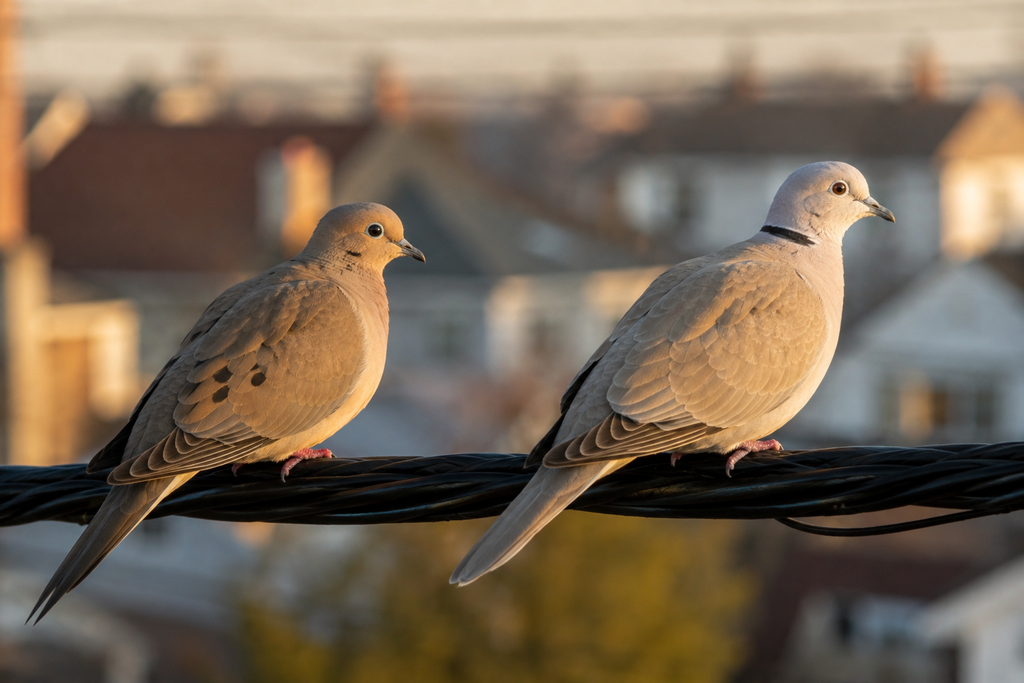
Five backyard bird pairs get confused constantly: downy vs. hairy woodpecker (settled by bill size), house finch vs. purple finch (settled by tail shape and how evenly the red color spreads), Cooper’s hawk vs. sharp-shinned hawk (settled by head shape and leg thickness), black-capped vs. Carolina chickadee (settled by size and song, except in their hybrid zone, where even the birds can’t tell), and mourning dove vs. Eurasian collared-dove (settled instantly by the black neck collar).
A woman in Missouri once watched a chickadee at her feeder for twenty minutes straight, camera ready, trying to decide if it was a black-capped or a Carolina. She never landed on an answer. Neither would an expert standing next to her. Some of these birds live in a ten-mile strip where the two species overlap, interbreed, and sing each other’s songs until nobody, not even a Cornell-trained ornithologist, can call it with confidence.
That’s the strange part about backyard bird identification. People assume the hard cases are the rare visitors, the warblers passing through for three days in May. The birds that actually trip up the most feeder-watchers are sitting right there every afternoon, eating the same sunflower seeds, looking almost but not quite like their closest relative.
Here are five pairs that get mixed up constantly, along with the detail that actually settles each one.
What’s the difference between a downy woodpecker and a hairy woodpecker?
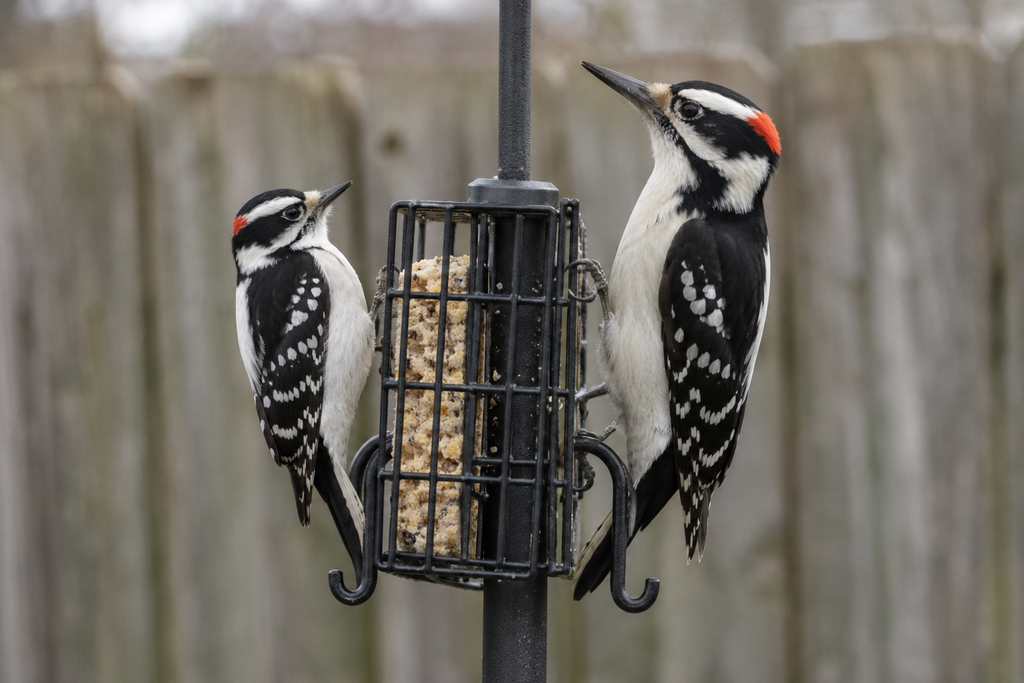
The fastest way to tell a downy woodpecker from a hairy woodpecker is bill size relative to the head. The downy’s bill is short and dainty, about a third of its head length. The hairy’s bill is nearly as long as its head. Downy woodpeckers also measure about 6.5 inches, closer to a house sparrow, while hairy woodpeckers reach 9.25 inches, closer to a robin.
These two are dressed almost identically: black and white bodies, a red patch on the back of the male’s head, the same undulating flight pattern. Beginners often give up entirely and call every black-and-white woodpecker a “downy,” since that name comes to mind first.
Size is the fastest tell in theory, but without something nearby to compare it to, a three-inch difference is hard to judge in the field. The bill solves that problem. Look for a stubby, almost invisible bill on a downy, and a bill that looks borrowed from a bigger bird entirely on a hairy.
One more clue for anyone who gets a good look at the tail: downy woodpeckers usually show small black bars on their white outer tail feathers. Hairy woodpeckers’ outer tail feathers tend to be plain white.
How do you tell a house finch from a purple finch?
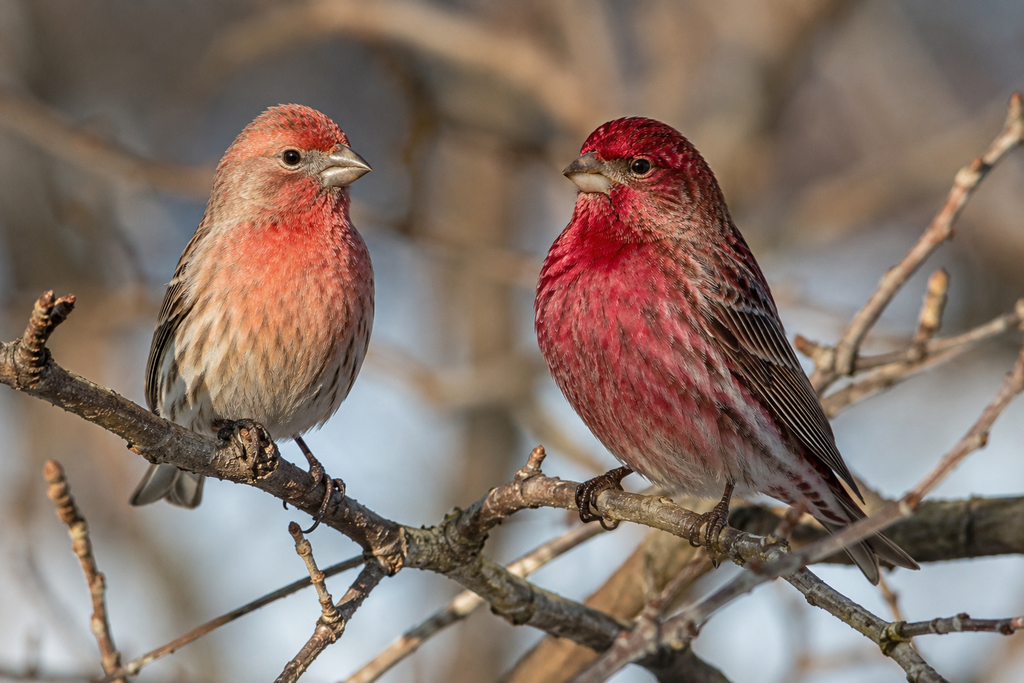
House finches and purple finches both show red on the head and chest, but the pattern differs. House finch red concentrates on the forehead and chest with brown streaking below. Purple finch color runs evenly from head to tail in a deeper raspberry shade. House finch tails are straight and extend past the folded wings; purple finch tails are shorter, notched, and mostly hidden by the wings.
Both are streaky brown birds with a wash of red, and both show up at the same tube feeders across most of the country, which is exactly why people confuse them. The difference comes down to how much red there is and where it sits.
A male house finch looks like it was dipped in red only at the top. A male purple finch looks fully saturated, more raspberry than fire-engine red, with color running evenly from head to tail. If you can see the wing, house finches show white wingbars, while purple finches show wingbars tinted the same reddish-purple as the rest of the bird.
Tail shape is the quiet giveaway once you know to check it. House finch tails stick out well past the folded wingtips. Purple finch tails are shorter and mostly covered by the wings when the bird is perched. Compare the two side by side at a feeder once, and it’s hard to mix them up again.
How can you tell a Cooper’s hawk from a sharp-shinned hawk?
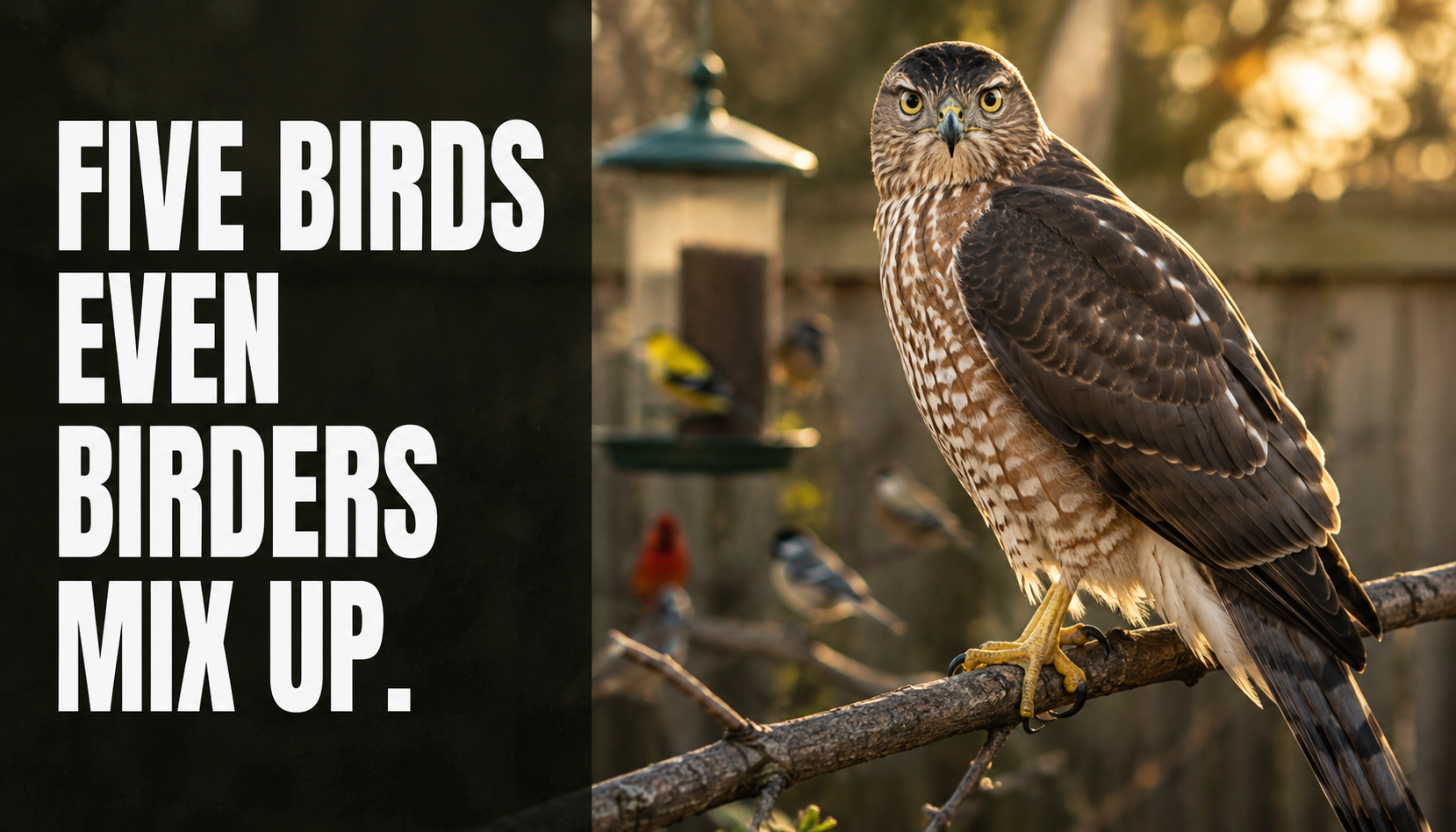
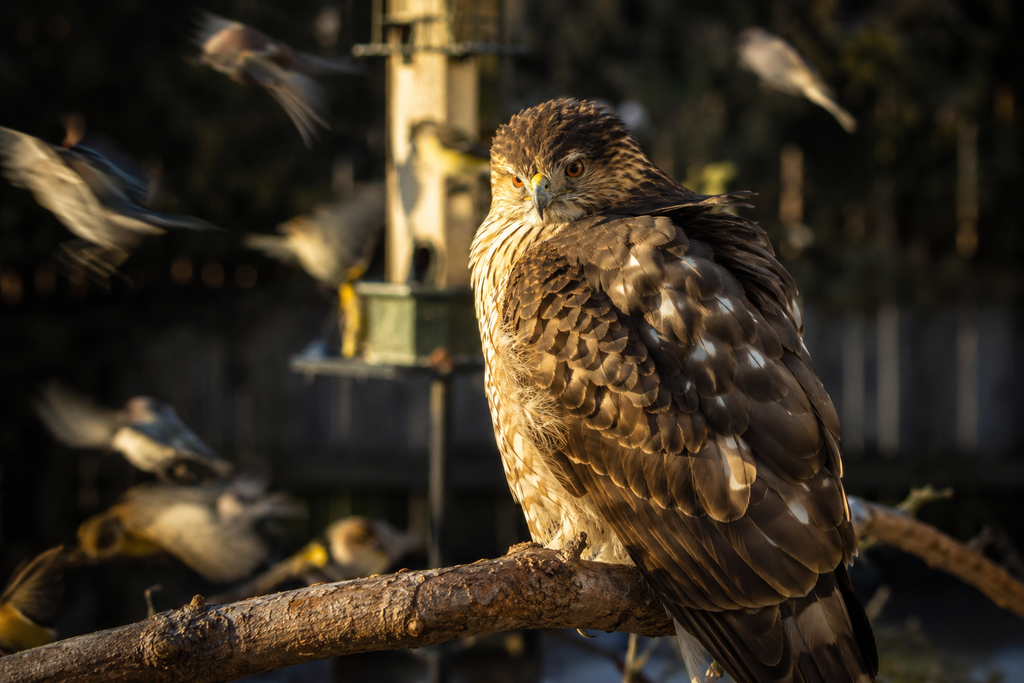
Head shape is the most reliable field mark for telling a Cooper’s hawk from a sharp-shinned hawk. Cooper’s hawks have a blocky head that projects past the wings in flight, with thick legs and a pale nape contrasting against a dark cap. Sharp-shinned hawks have a smaller, rounder head, thin pencil-like legs, and a nape that blends into the back without contrast.
Feeder watchers usually meet this pair the hard way: a blur of gray and orange scattering every bird on the lawn in half a second. Cooper’s hawks and sharp-shinned hawks are both accipiters built for exactly that kind of ambush, and size alone won’t separate them, since a large female sharp-shinned can outweigh a small male Cooper’s.
Head shape holds up better than size. A Cooper’s hawk’s head projects noticeably past the front of the wings in flight. A sharp-shinned hawk’s head barely clears that same line. The nape helps too: adult Cooper’s hawks show a pale nape with a dark cap that contrasts sharply, while a sharp-shinned’s color runs solid from crown to back.
Legs are the detail longtime birders reach for last. Cooper’s hawks have noticeably thicker legs. Sharp-shinned hawks have thin, almost pencil-like legs that look too delicate for a bird that just took down a chickadee.
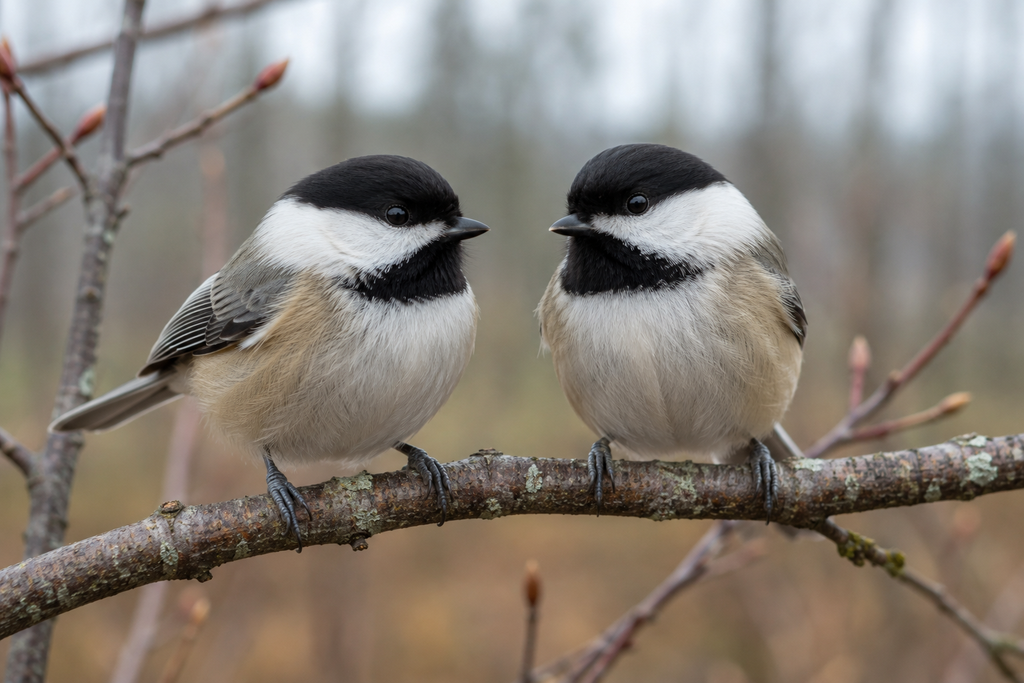
Why are black-capped and Carolina chickadees so hard to identify?
Black-capped and Carolina chickadees look nearly identical, and along a narrow overlap zone from New Jersey to Kansas the two species interbreed and learn each other’s songs, making some individual birds impossible to identify with confidence. Outside that zone, black-capped chickadees are slightly larger with more white in the wing, while Carolina chickadees are smaller and plainer, and their calls differ in speed and pitch.
This is the pair that humbles everybody, including the birds themselves. Across most of their range, black-capped and Carolina chickadees never meet and identification isn’t a problem. Along that narrow band from New Jersey to Kansas, though, the two species overlap, interbreed, and raise chicks that carry traits of both parents.
In that zone, chickadees learn each other’s songs. A bird can end up singing the wrong species’ tune entirely, or some hybrid version that matches neither. Researchers who study this contact zone have said plainly that some individual birds simply can’t be identified with confidence.
Outside the overlap strip, there’s an easier rule. Black-capped chickadees are slightly larger, with a longer tail and more white edging in the wing feathers. Carolina chickadees are a touch smaller and plainer looking. The calls differ once you’ve heard both: black-capped sings a clear two-note “fee-bee,” Carolina sings a faster four-note phrase. Inside the hybrid zone, though, even that won’t always save you.
How do you identify a Eurasian collared-dove versus a mourning dove?
The clearest way to identify a Eurasian collared-dove versus a mourning dove is the neck marking. Collared-doves show a bold black band across the back of the neck, while mourning doves have only a small dark smudge below the eye. Collared-doves are larger, paler, and squared-tailed; mourning doves are smaller, warmer brown, spotted on the wings, and have a long pointed tail.
Anyone whose yard has quietly filled up with new doves over the past decade has probably watched this identification problem play out in real time. Eurasian collared-doves are native to Asia and southeastern Europe. About 50 birds escaped captivity in the Bahamas in the 1970s, reached the Florida mainland by the early 1980s, and have been expanding across North America ever since. Where mourning doves used to have backyard feeders to themselves, the two species now overlap almost everywhere outside the Northeast.
The collar is the fastest tell when it’s visible. Eurasian collared-doves have a bold black band across the back of the neck. Mourning doves have only a small dark smudge below the eye and no collar at all. Tail shape works from a distance too: mourning doves have a long, pointed tail, while collared-doves have a squared-off tail with a white band visible from below.
Size and color separate them further. Collared-doves are larger and paler, almost a chalky gray-tan. Mourning doves are smaller, warmer brown, and marked with small black spots across the wings that collared-doves lack entirely.
None of this makes anyone a bad birder for mixing these up. Even the chickadees can’t always tell each other apart, and they’ve had a lot longer to practice.