The fastest way to identify an unfamiliar backyard bird is to work through four checks in order — size and shape, then behavior, then habitat, and only then color. Professional birders use this exact sequence, known as the Cornell Lab of Ornithology’s Four Keys to Bird Identification, to narrow a continent’s worth of species down to a shortlist in about two seconds.
You catch movement at the feeder — gray, maybe brown, gone before your eyes even focus. By the time you’ve grabbed your phone and typed “small gray bird backyard” into a search bar, the moment’s long over and you’re staring at forty photos that all look vaguely right and definitely wrong.
Here’s what beginners get backwards: they reach for color first, when it’s actually the last and slowest of the four keys. Skilled birders read shape, movement, and location before a single feather color even registers — a habit that works on a chickadee at a suet feeder in Maine and a towhee scratching through leaf litter in Texas, even when the bird gives you two seconds and a bad angle.
Flip open a field guide without any of that groundwork and you’re comparing your two-second glimpse against six hundred lookalike thumbnails, hoping one jumps out. Most beginners give up right there — not because they lack the eye for it, but because they’re solving the puzzle backwards. Start with the shape. The color was never the hard part.
What Should You Look At First, Before Color?
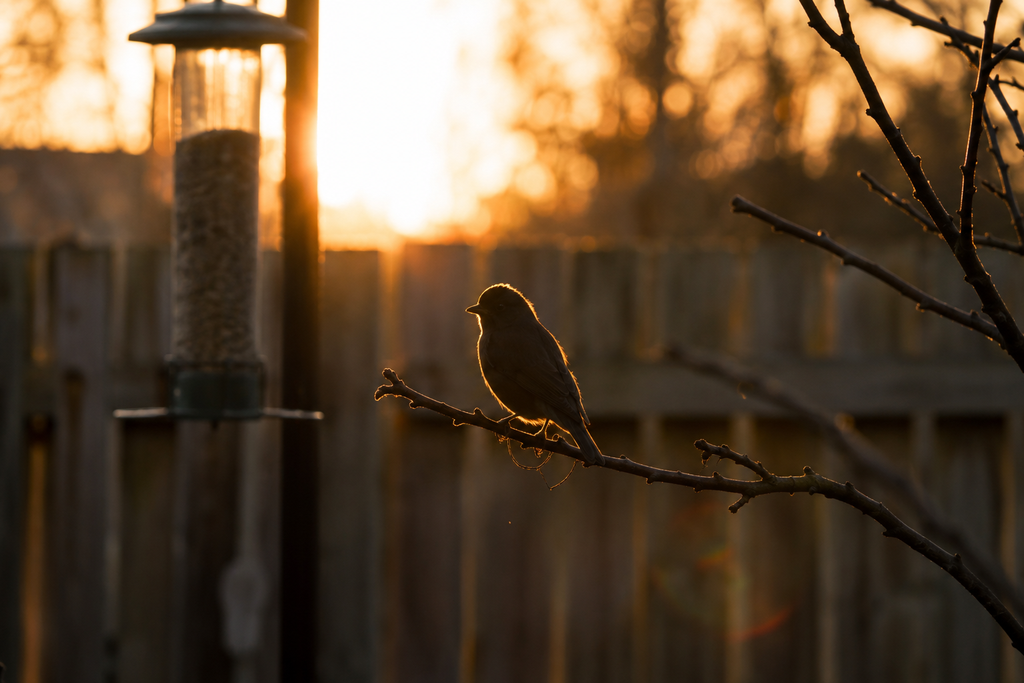
Compare the bird’s outline to a familiar reference — smaller than a sparrow, bigger than a robin, chunkier than a chickadee. Bill shape reveals diet fast: thick and conical means seed-cracker, thin and pointed means insect-hunter. Tail length, tail shape, and posture add more detail. None of this needs good light or color, which makes it the fastest key to use on a fast-moving or backlit bird.
Try this the next time something lands at your feeder: before you let yourself notice the colors, ask what the outline reminds you of. Robin-sized? Sparrow-sized? Chunky like a cardinal, or slim like a chickadee? That one comparison alone usually cuts your possibilities by more than half.
Posture matters too. Some birds perch upright and alert; others slouch low and horizontal along a branch, tail drooping. You can read all of this from a silhouette against a bright sky — exactly the situation where color tells you nothing at all.
Bill shape alone sorts birds into rough diet categories before you’ve noticed anything else. A short, thick, cone-shaped bill built for cracking seed shells belongs to cardinals, finches, and sparrows. A thin, needle-like bill built for picking insects out of bark or leaves belongs to warblers, wrens, and vireos.
Woodpeckers carry a straight, chisel-like bill for excavating wood, while hummingbirds carry the opposite extreme — long, thin, and built for reaching deep into flowers. None of these bill types require you to see color to identify; the outline does the work in silhouette, even against a bright window or an overcast sky.
Color also shifts with age and season in ways shape never does. A juvenile robin is heavily spotted rather than solid orange-red, and many songbirds molt into duller winter plumage that barely resembles their breeding colors. Shape and bill stay constant through all of that. A robin-shaped bird with a robin-shaped bill is still worth comparing to a robin, spots or no spots, brown or rust.
How Much Can A Bird’s Behavior Actually Tell You?
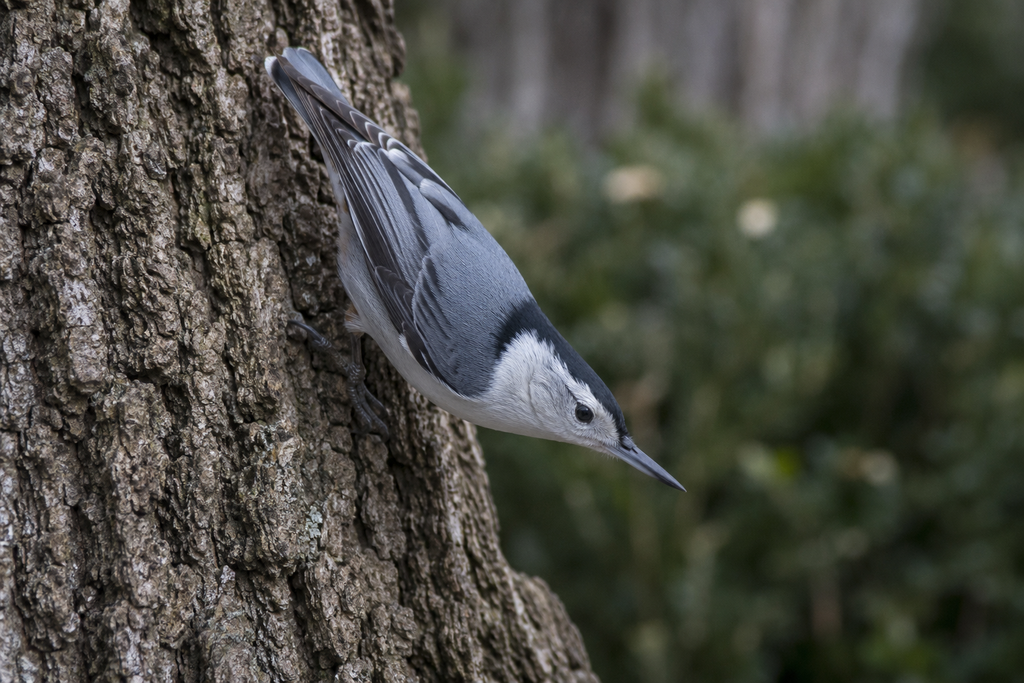
A bird’s movement can identify it faster than color ever will. Nuthatches creep headfirst down tree trunks — no other common feeder bird does that. Woodpeckers brace against bark with stiff tail feathers and climb upward in hops. Ground-feeders like juncos double-scratch backward with both feet at once. Watch for a few extra seconds before reaching for your phone; the behavior is usually the giveaway.
At the feeder, behavior keeps sorting things for you even after the first glance. Some birds cling to a hanging feeder and stay put, working through seed after seed. Others land, grab a single seed, and retreat to a branch to crack it open before coming back for more.
Small motions matter just as much as full behaviors. Tail-pumping, wing-flicking, the constant bob of an Eastern Phoebe’s tail, the odd sideways hop of a towhee working through leaf litter — these are as identifying as any field mark, and none of them require binoculars. They just require patience most beginners skip.
Flight pattern is another behavior clue you can read from a distance, often before the bird ever lands. Woodpeckers and goldfinches share a bounding, undulating flight — a few quick wingbeats, then a dip, then more wingbeats, so the bird seems to ride a wave through the air. Swallows and swifts cut a completely different shape overhead, banking and looping in continuous acrobatic flight built for catching insects mid-air.
Sparrows and finches mostly fly in a straighter, more direct line, wingbeats steady and unbroken. Crows hold that same steady wingbeat but at a much larger scale, with slow, deliberate flaps that read as unhurried even at a distance.
Many backyard birds travel in mixed flocks outside of breeding season, and that grouping habit is itself a clue. Chickadees, titmice, nuthatches, and downy woodpeckers commonly forage together through fall and winter, moving from tree to tree as a loose group. Spotting one usually means the others are close by, which can help confirm or rule out an ID based on who else showed up in the same five minutes.
Why Does Location Matter Before You’ve Even Studied The Bird?
Location and season eliminate entire groups of birds before you study a single feather. A bird in a dense hedge isn’t competing with the same possibilities as one at the top of a bare tree or working mud at a pond edge, and the birds plausible at your feeder in January differ completely from May. Project FeederWatch has tracked these seasonal and regional patterns since 1976, currently with more than 20,000 participants across North America.
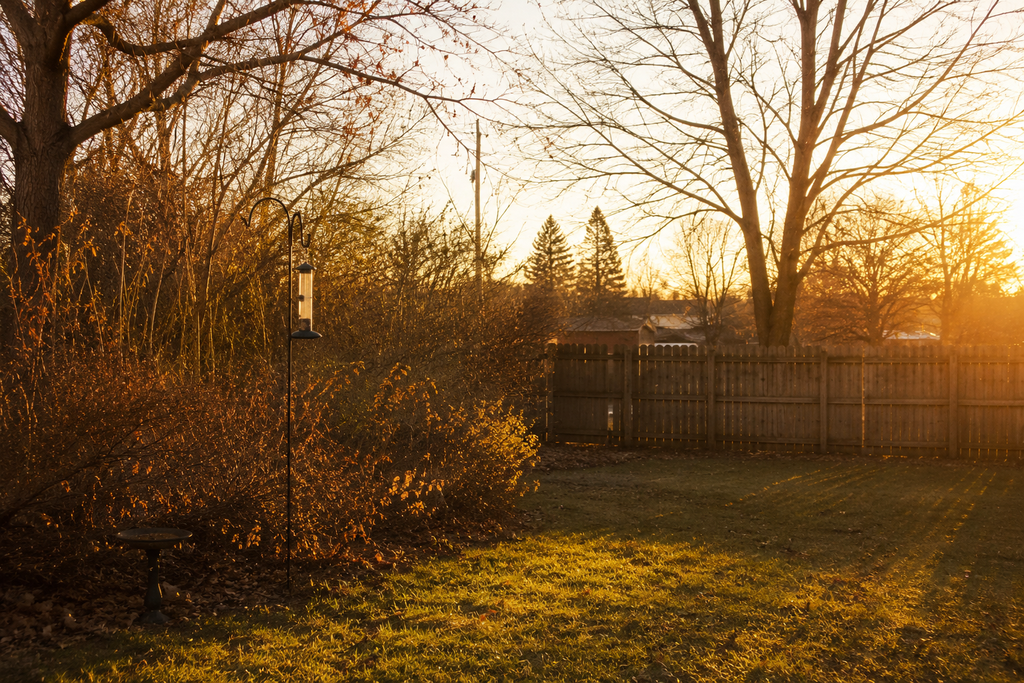
Habitat isn’t just a location on a map — it’s also a layer of the yard. Warblers and tanagers tend to work the high canopy, foraging among leaves well above eye level. Chickadees, titmice, and nuthatches work the middle story, moving through shrubs and lower branches and tree trunks. Sparrows, juncos, and towhees mostly stay low, working the ground and leaf litter beneath the feeder rather than the feeder itself. Knowing which layer a bird favors narrows your search before you’ve even matched a color or a call, and it’s often the first thing a mystery bird’s location tells you.
That’s a genuinely useful sanity check on your own guesses. If the bird you’re trying to identify has never once shown up on your region’s feeder counts, you’re probably misreading something common rather than looking at something rare. Build a rough mental list of what’s actually likely in your yard this month, and let it rule out the impossible before you go hunting through a field guide for the improbable.
You don’t need to join FeederWatch to benefit from its data. Its public Top 25 lists, broken down by state and province, show which species are actually being reported at feeders near you each season — a quick way to sanity-check a guess without leaving your kitchen window.
When Should Color Pattern, And An App Like Merlin, Come In?
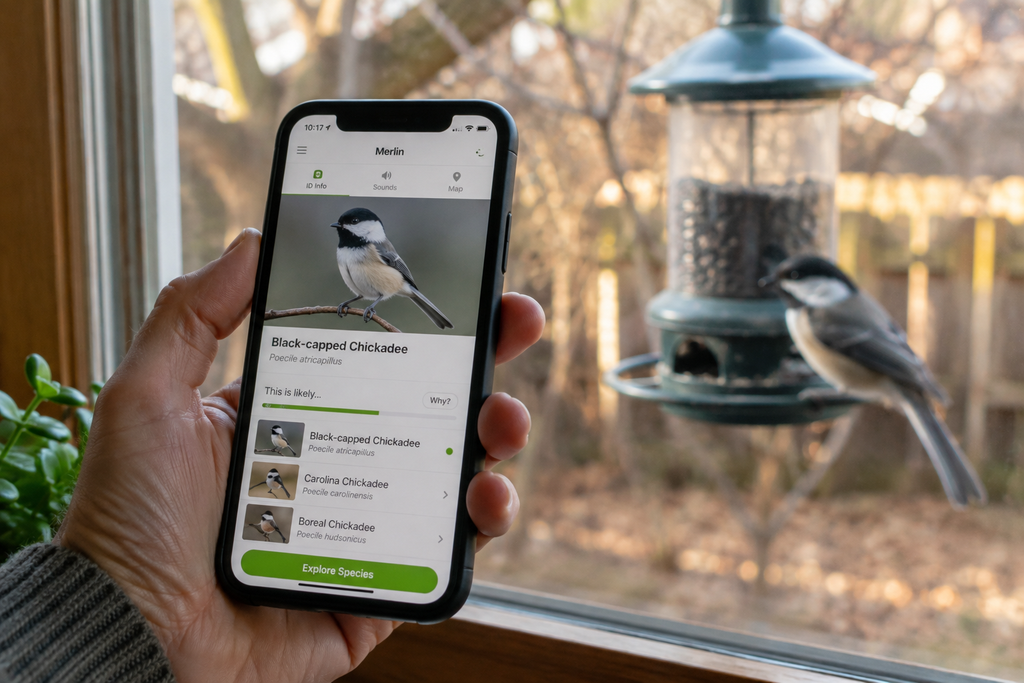
Color pattern is the last key, not the first — look for contrast, eye rings, wing bars, and where color breaks at the throat or belly. The free Merlin Bird ID app from Cornell Lab can confirm a guess through a photo, five quick questions, or its Sound ID feature, which now covers more than 2,000 species. Use it to check your own work, not to replace doing it.
A handful of terms do most of the work once you’re at the color stage. A wing bar is a pale stripe crossing the folded wing, often doubled. An eye ring is a thin circle of color around the eye; an eye line runs straight through it instead. A rump patch shows only in flight, a flash of color at the base of the tail. Learning to spot these five or six marks covers the vast majority of backyard look-alikes.
Used after you’ve already worked through size, shape, behavior, and habitat in your own head, an app is confirmation — a second opinion that speeds up learning. Used instead of that process, it’s a crutch that never actually teaches you to recognize the next bird on your own, which is the whole point of learning this in the first place.
Merlin’s suggestions are built on eBird, the same database birders around the world use to log sightings, so its guesses reflect what’s actually being seen nearby and not just a generic species list. That’s part of why it works well as a check rather than a first step — it’s already filtering for what’s plausible in your location, the same narrowing you did yourself with habitat and season.
Photo ID works the same way in reverse — upload a picture instead of describing field marks, and Merlin cross-references shape, color, and location together in one pass. It’s a fast way to double-check a trickier bird once you’ve already done the groundwork of watching it.
The habit is what sticks, not any single correct answer. Every bird you talk yourself through this way — size, then behavior, then habitat, then color — trains the same instinct a little further, until one day you catch a smudge of movement in a hedge and just know, before you’ve consciously worked through a single step, exactly what just flew past.