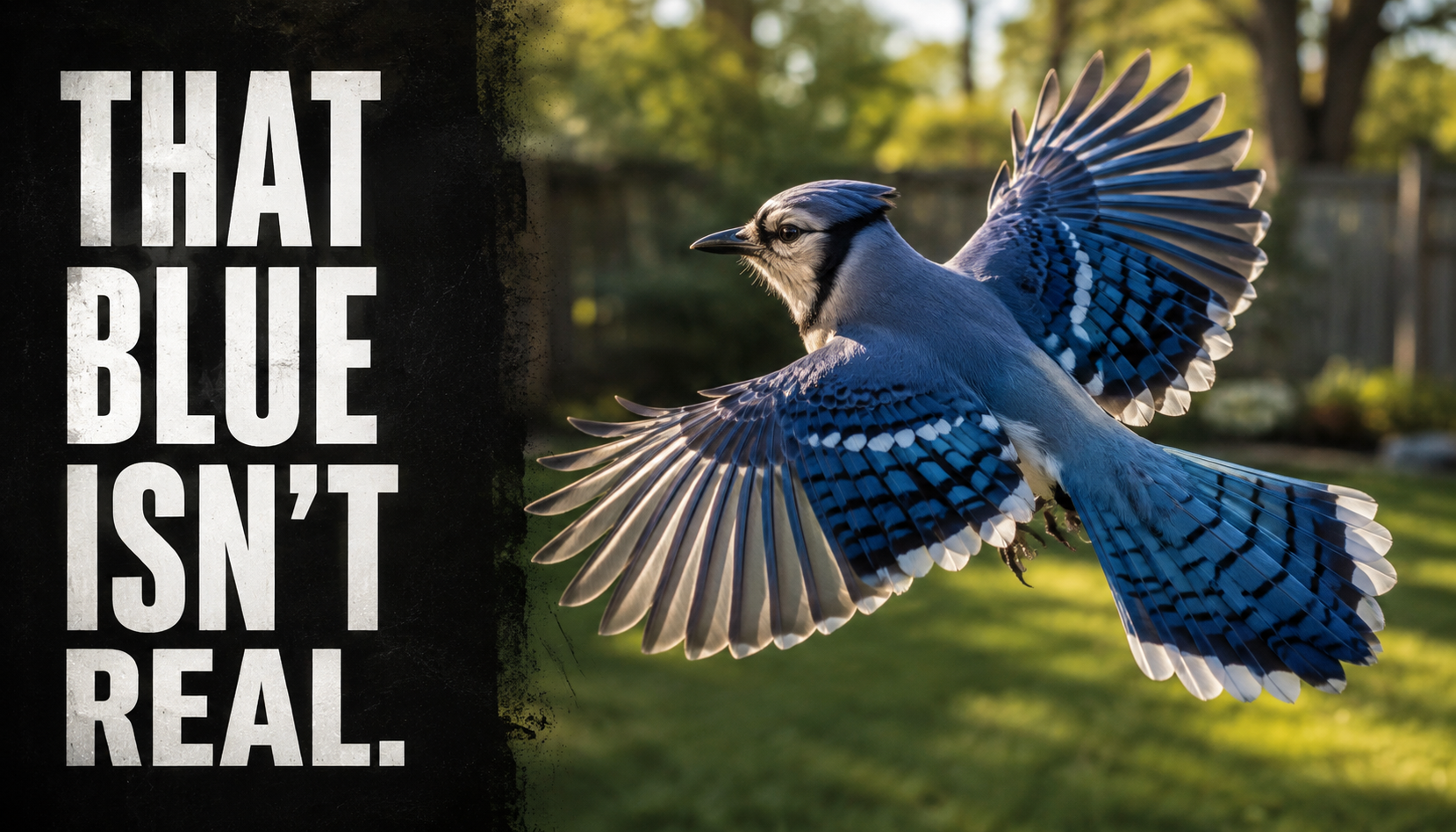
That flash of vivid blue in your yard is almost certainly a blue jay — but the color itself isn’t real. Blue jays carry zero blue pigment; their feathers use structural coloration, with microscopic keratin structures scattering blue light over a base of brown melanin underneath. Crush the feather and the blue vanishes instantly, leaving only dull brown dust behind, because the light-scattering structure itself has been destroyed.
You’re refilling the feeder, or maybe just walking to the mailbox, and something streaks past the corner of your eye. Blue. Not a faded, dishwater blue — a hard, saturated, almost cartoonish blue, gone again before you can turn your head. You look around like you imagined it. You didn’t.
Nine times out of ten across the eastern and central U.S., that flash belongs to a blue jay: loud, opinionated, impossible to miss once it lands and starts hollering at everything in a two-tree radius. But here’s the part that trips people up once they actually learn it — that bird isn’t blue. Not in the way you think. There’s no blue pigment anywhere on its body. None. The color you just saw is, in a very real sense, an optical trick, and once you know how it works, you won’t look at a jay the same way again.
What Bird Was That Flash of Blue in Your Yard?
In most of the eastern and central United States, that flash of saturated blue is almost always a blue jay — a crested, robin-sized songbird with a black necklace marking, white cheeks, and a loud, unmistakable call. Farther west, or in open shrubby areas, it might be an indigo bunting, blue grosbeak, or lazuli bunting instead. All four are common backyard sightings.
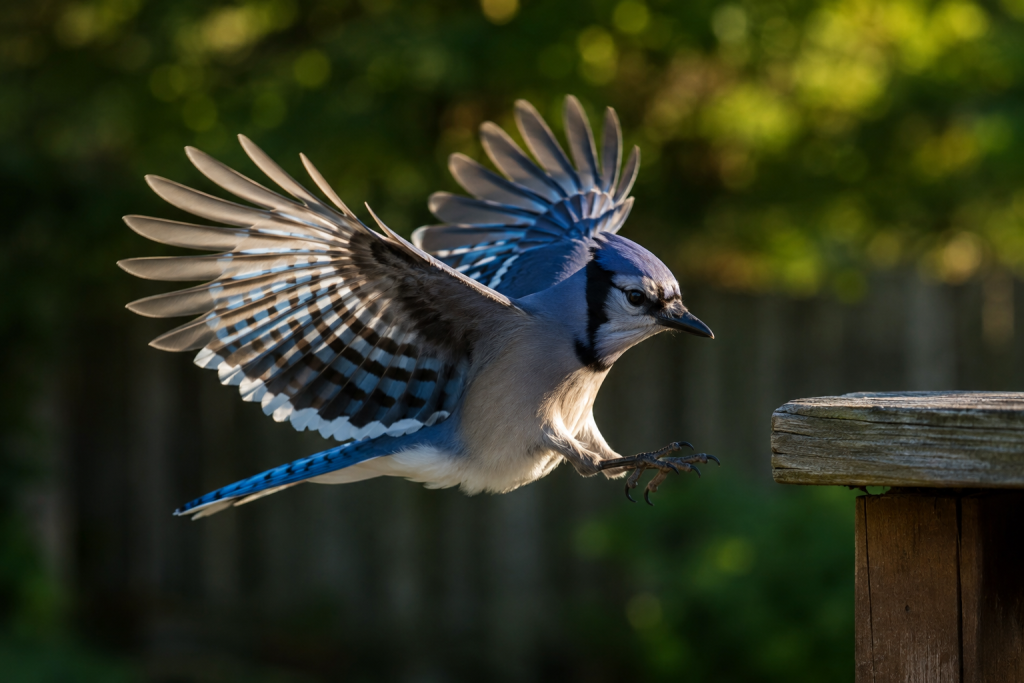
Blue jays are hard to mistake once you get a clean look: a pointed crest, a black band running around the neck like a loose necklace, white face and underparts, and wings barred in blue, black, and white. They stick around year-round through most of their range rather than fully migrating, and they’re not shy about announcing themselves — that harsh jay-jay call carries across a whole yard. Some jays even mimic the scream of a red-shouldered hawk, which scatters smaller birds off a feeder just long enough for the jay to move in.
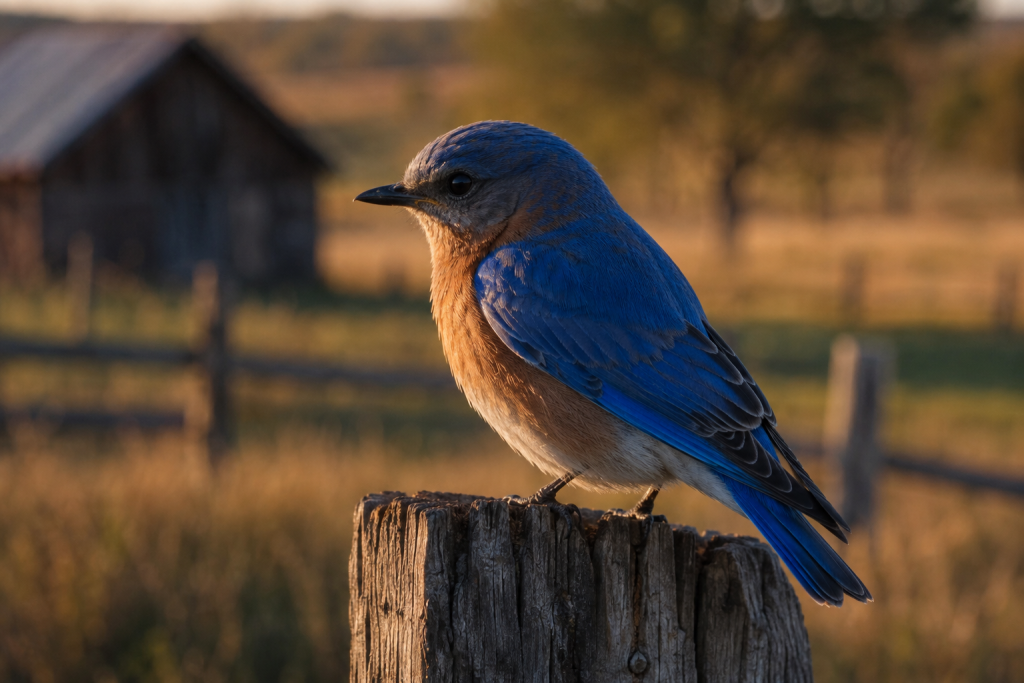
If you’re west of the Rockies, or standing near a brushy field edge instead of a feeder, the flash might belong to something else entirely — an indigo bunting, finch-sized and shy, or a lazuli bunting with its warm orange chest. Different bird, same underlying trick.
Why Don’t Blue Jays Have Any Blue Pigment?
A blue jay’s feathers contain no blue pigment at all. The blue comes from structural coloration: microscopic keratin structures in each feather barb scatter blue wavelengths of light while a layer of brown melanin underneath absorbs the rest. Every genuinely blue bird on Earth — bluebirds, buntings, grosbeaks — produces its color the same way, through physics rather than chemistry.
Birds get color from two completely different systems, and people usually assume all of it works the same way. It doesn’t. Reds, oranges, and yellows come from pigments called carotenoids, which birds build from what they eat — a cardinal really is carrying red compounds in its feathers, sourced straight from its diet. Blacks and browns come from melanin, another real pigment, manufactured inside the bird’s body.
Blue works differently. David Wiedenfeld, an ornithologist with the American Bird Conservancy, has compared a blue feather to a prism: light hits the structure and gets divided, with only certain wavelengths bouncing back out toward your eye. The feather barbs are packed with a foam-like nanostructure — a random, spongy arrangement of keratin and air pockets — that happens to be exactly the right scale to scatter blue wavelengths back at the viewer while letting the rest pass through to a layer of brown melanin, which quietly absorbs it. No blue pigment required. No blue pigment even possible, as far as researchers have ever found in any bird species on the planet.
How Can You Prove a Blue Jay’s Color Isn’t Real Paint?
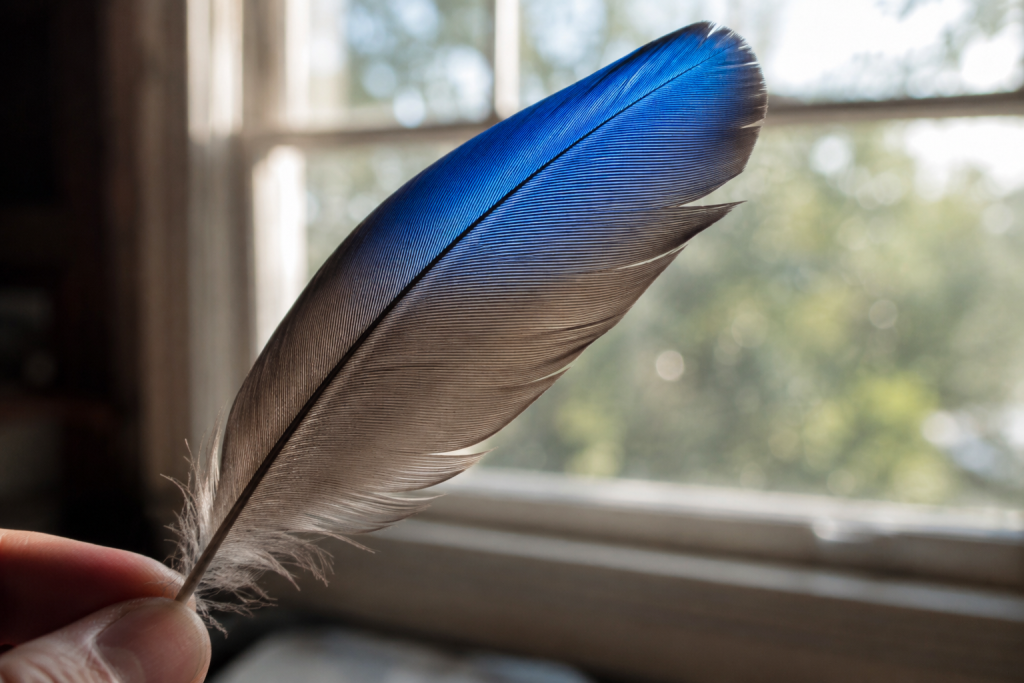
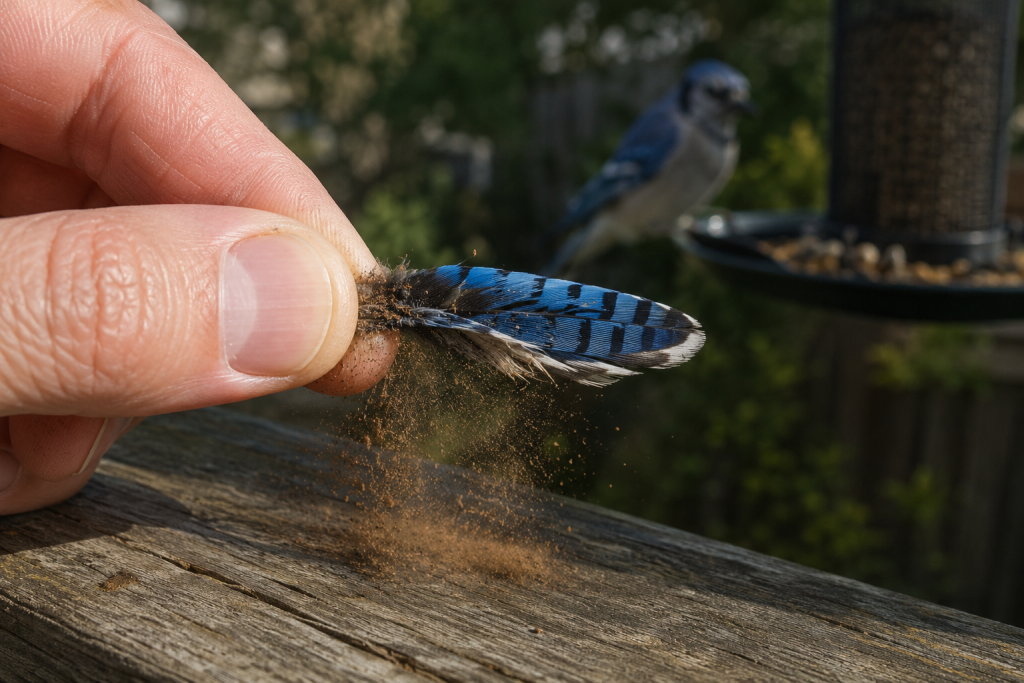
Pick up a molted blue jay feather and crush it between your fingers — the blue vanishes, leaving dull brown dust, because you’ve destroyed the nanostructure that scatters light. Hold an intact feather up to backlight instead of front light and it turns gray-brown too. Researchers confirmed this with solvent experiments over a century ago, and electron microscopy has since mapped the exact structure responsible.
This isn’t a new observation. Robert Hooke, one of the earliest microscopists, noticed centuries ago that wetting certain feathers changed their color, which was itself a clue that pigment wasn’t the whole story. A researcher named Clyde Mason later ran a cleaner version of the same test, soaking blue jay feathers in different solvents and watching the blue shift or disappear depending on how each liquid bent light. Pigment doesn’t behave that way. Structure does.
You can run a rough version of this yourself with a feather picked up off the lawn — jays molt often, and their tail and wing feathers turn up in yards constantly. Hold it toward a window with light coming through from behind instead of in front, and the vivid blue collapses into gray. Crush a section between your fingers and the powder that comes off is brown, not blue, because you’ve physically wrecked the microscopic scaffolding responsible for the color and exposed the melanin underneath. A 2015 study using electron microscopy on the closely related Eurasian jay mapped that structure directly: a random, foam-like network of keratin roughly 150 nanometers across, fine-tuned by evolution to bounce blue wavelengths back toward your eye.
What Other Backyard Birds Use the Same Blue Trick?
Eastern bluebirds, indigo buntings, blue grosbeaks, and lazuli buntings all get their blue through the same light-scattering trick blue jays use — no bird species has ever been found with true blue feather pigment. Reds and yellows, by contrast, come from real dietary pigments called carotenoids. Iridescent birds like grackles add a second layer of physics, shifting color with viewing angle.
Once you know to look for it, the pattern shows up everywhere. Eastern bluebirds do it. Indigo buntings — which look almost unnaturally saturated in full breeding plumage — do it. Blue grosbeaks and lazuli buntings do it too. Every one of them is running the identical optical setup as the jay screaming at your feeder: a nanostructured keratin layer scattering blue light over a base of light-absorbing melanin.
Common grackles take the whole thing a step further. Their feathers use a thin-film layering effect on top of the same structural principle, which means the color actually slides depending on where you’re standing — blue from one angle, bronze-gold from another. Stand on a hillside and look down at a grackle in the sun and it can read as flat black with a gold sheen. Watch that same bird fly up above you and it can flash blue instead. Nothing about the bird changed. Only the angle did.
So the next time that flash cuts across the yard and vanishes before you can name it, you’re not just watching a bird. You’re watching light get bent, sorted, and thrown back at you by a structure smaller than a red blood cell. That part your eyes got right. The color itself was never really there.