A bird’s decision to migrate runs on shrinking daylight and the hormonal chain reaction it sets off inside the brain, not on whether your feeder still has seed in it. Cornell Lab of Ornithology researchers have said outright that keeping feeders stocked through late summer has no measurable effect on when a bird actually leaves.
I heard the opposite for years. A neighbor swore that if I kept the hummingbird feeder up past Labor Day, “she’ll just stay and freeze.” So every September I’d take it down early, watch the yard go quiet, and feel vaguely guilty about it — like I’d been running some kind of avian daycare that needed to close on schedule. Turns out the guilt was misplaced. The birds were never taking their cues from me, and they never had been.
WHAT ACTUALLY TRIGGERS BIRD MIGRATION?
Migration timing is controlled by shrinking or lengthening daylight, sensed by photoreceptors deep in a bird’s brain rather than through its eyes. That shift triggers a hormonal cascade — testosterone, corticosterone, and thyroid hormones T3 and T4 — which drives hyperphagia, or rapid fat storage, and Zugunruhe, restless directional activity at night. Pine siskin research shows this state switches on at roughly 12 hours of daylight, regardless of food availability.
Birds sense day length through photoreceptors buried deep in the brain itself, not through their eyes — researchers have documented the response even in blind individuals, which tells you the mechanism has nothing to do with what a bird happens to be looking at, or looking for, in your backyard. As daylight shifts, that sets off a hormonal cascade: rising or falling testosterone, corticosterone, and the thyroid hormones T3 and T4, which together drive two things you can actually watch happen.
One is hyperphagia, an aggressive bout of fat storage that can nearly double a bird’s body weight in a matter of weeks. The other is Zugunruhe, the restless, directional hopping and wing-fluttering ornithologists have recorded in caged birds for decades, always erupting on schedule whether or not there’s food sitting in front of them.
Researchers studying pine siskins — a species that migrates irregularly depending on conditions rather than on a fixed calendar — found the migratory state switches on once day length crosses roughly a 12-hours-light, 12-hours-dark threshold, a finding that held across different latitudes and different feeding setups. Even facultative migrants, the ones whose travel plans are supposedly more flexible than a robin’s or a warbler’s, answered to daylight first. Food determines how fast a bird can fuel up for the trip ahead. It doesn’t touch the switch that decides whether the trip happens at all.
The way researchers actually test this is almost comically direct: keep captive birds on an artificial light cycle, control what and how much they’re fed, then watch for Zugunruhe and fat gain anyway. Well-fed birds on a shortening photoperiod still get restless at night and still pack on weight for a flight nobody’s forcing them to take. Take away the food and the restlessness doesn’t disappear — the bird just has less fuel in reserve when it finally goes.
HOW MUCH OF A BIRD’S DIET COMES FROM FEEDERS?
Backyard feeders typically supply only about a quarter of a wild bird’s daily nutrition — the rest comes from insects, wild seed, and natural forage the bird would find regardless. Ruby-throated hummingbirds, often assumed to depend on feeders, can fly 500 nonstop miles across the Gulf of Mexico on fat reserves built mainly from insects and natural nectar. A feeder is one fuel stop, not the whole food supply.
Studies on backyard feeding keep landing on roughly the same figure: a feeder supplies about a quarter of a wild bird’s daily nutrition, and for a lot of species it’s less than that. The rest comes from insects, wild seed, berries, and whatever else the bird would be finding with or without your intervention. Summer actually raises the stakes on that natural foraging, not lowers them — parents feeding a nest of hungry chicks burn through calories fast, and most songbirds are stuffing their nestlings with protein-rich insects rather than sunflower seed regardless of what’s hanging in the yard.
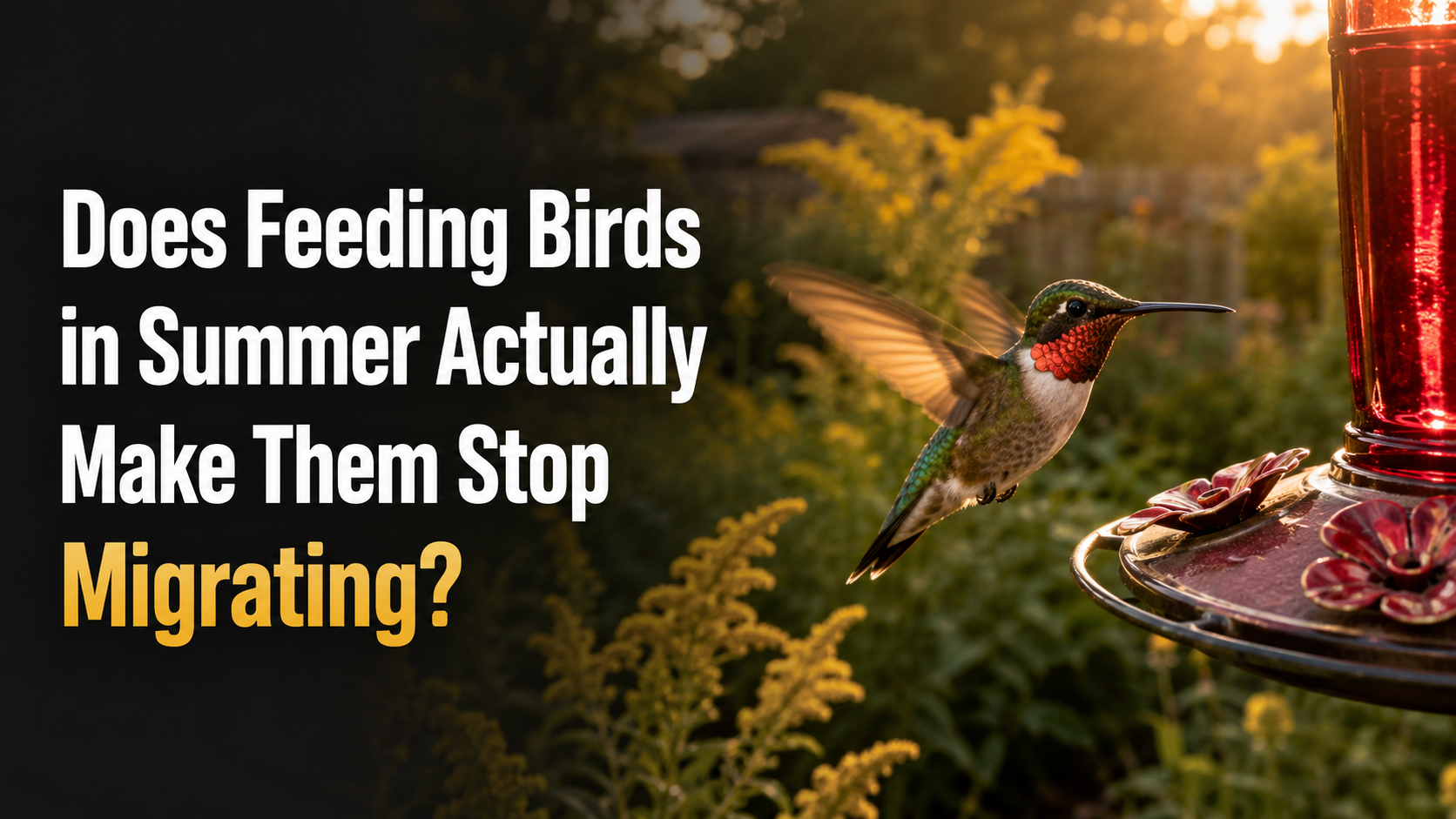
Ruby-throated hummingbirds get the most worry, probably because a feeder can look like a hummingbird’s entire universe by August. It isn’t. A Ruby-throat can cross 500 miles of open Gulf water without a single stop, running on fat reserves built mostly from insects and natural nectar over the preceding weeks. Your feeder is one stop on that route, not the whole pantry. Pull it in July and the hummingbird doesn’t cancel the trip — it just finds the same calories somewhere else and leaves on the internal schedule it was always going to keep, sugar water or none.
WHY DOES IT LOOK LIKE THE SAME BIRDS ARE STICKING AROUND?
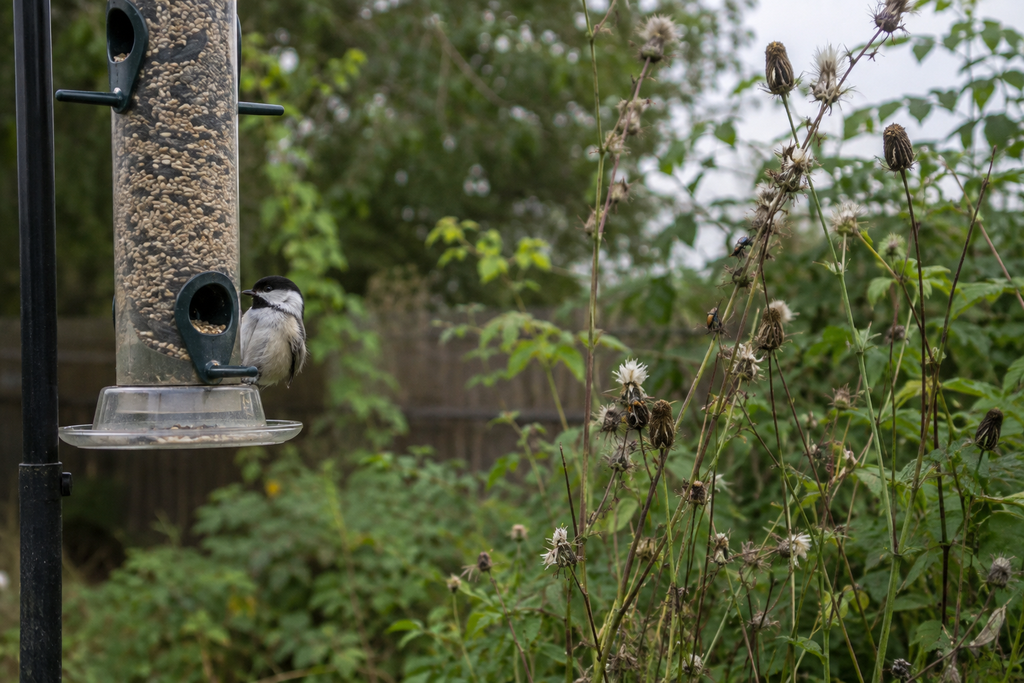
The illusion comes from population turnover, not individual birds refusing to leave. Migrants who spent summer at a feeder typically depart on schedule and get replaced by new arrivals of the same species moving down from farther north, making the feeder look constantly occupied. Add in species like chickadees, cardinals, and blue jays that never migrate at all, and a feeder can appear migration-proof when it is really just hosting several different birds.
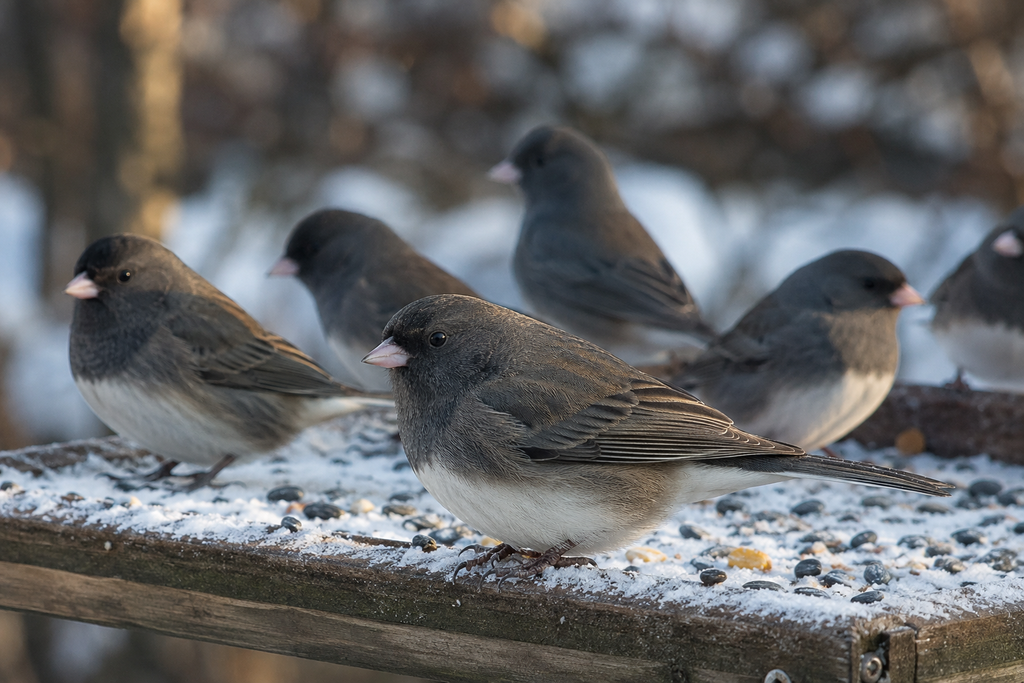
This is where the myth gets its staying power, and it isn’t really about biology — it’s about how bad humans are at telling one junco from another. A feeder mobbed with juncos in October and just as mobbed in November reads, to the eye, like a population that quietly decided to skip its flight south.
What’s actually happening is stranger and quieter than that. The individual migrants who spent the summer in your yard have likely already left, replaced by a fresh wave of the same species arriving from farther north — birds that will themselves move on in a few weeks once the next wave shows up behind them. The population at your feeder looks unchanged, day to day. The birds inside it never are.
Then there’s the other half of the illusion: plenty of feeder regulars never migrate at all. Chickadees, titmice, cardinals, blue jays, most woodpeckers — they’re year-round residents by nature, not birds your feeder talked out of leaving. Pull every feeder in October out of migration-guilt and you’re not protecting anyone’s flight south. You’re just cutting off the ones who were always going to ride out winter three yards over from where they hatched.
It also helps to remember how many species people lump together as “the birds at my feeder” without realizing they’re watching several overlapping migrations at once. A white-throated sparrow passing through in late September has nothing to do with the chickadee that’s been in the same maple all year, and neither of them has anything to do with the warbler that stopped for two days on its way to Central America. Three completely different migration stories, one feeder, one confused observer taking notes from the kitchen window.
WHAT HAPPENS IF YOU PULL THE FEEDER TOO SOON?
The real risk runs opposite to the myth: removing feeders too early can hurt late migrants, inexperienced young birds, and anyone delayed by bad weather or drought who still needs a reliable refueling stop. Cornell Lab of Ornithology recommends keeping feeders stocked for two to three weeks after a species’ last regular visitor disappears. Switching to higher-fat foods like peanuts, suet, and Nyjer seed in late summer also gives migrants denser fuel for the trip ahead.
If there’s a genuine feeding mistake tied to migration, it runs the opposite direction from the myth — taking feeders down too early, not leaving them up too long. Late migrants, young birds on their first solo trip, and anyone caught by a stretch of bad weather or drought all lean harder on a reliable food source than the birds that departed on schedule in good condition.
Cornell’s own guidance is to keep feeders filled for two to three weeks after the last regular visitor of a given species disappears, specifically so stragglers passing through still have somewhere to refuel before the next long leg.
Warm-weather feeding does call for a couple of adjustments, though, and they have nothing to do with migration timing. Suet turns rancid fast in summer heat and can smear into feathers, so a peanut-butter-and-cornmeal mix or a switch to more frequent seed changes solves that without pulling feeders altogether. Keeping water available matters just as much in a dry August as fresh seed does, especially in a drought year when natural sources dry up before the birds have finished raising their broods.
Come late summer, switching toward higher-fat, higher-calorie offerings — shelled peanuts, suet once temperatures cool, nectar, Nyjer seed — gives passing migrants a denser fuel source right when they need to be packing on reserves fastest, rather than stretching out a slow trickle of plain seed. It’s a shift in what you’re offering, not a countdown to when you take the feeder down.
None of it was ever complicated. The timing question was never about birds waiting on permission from us to leave. My neighbor’s hummingbird was always going to go when her own body told her to, feeder or not. I just spent a few Septembers trading the birdwatching for guilt I didn’t need to feel.